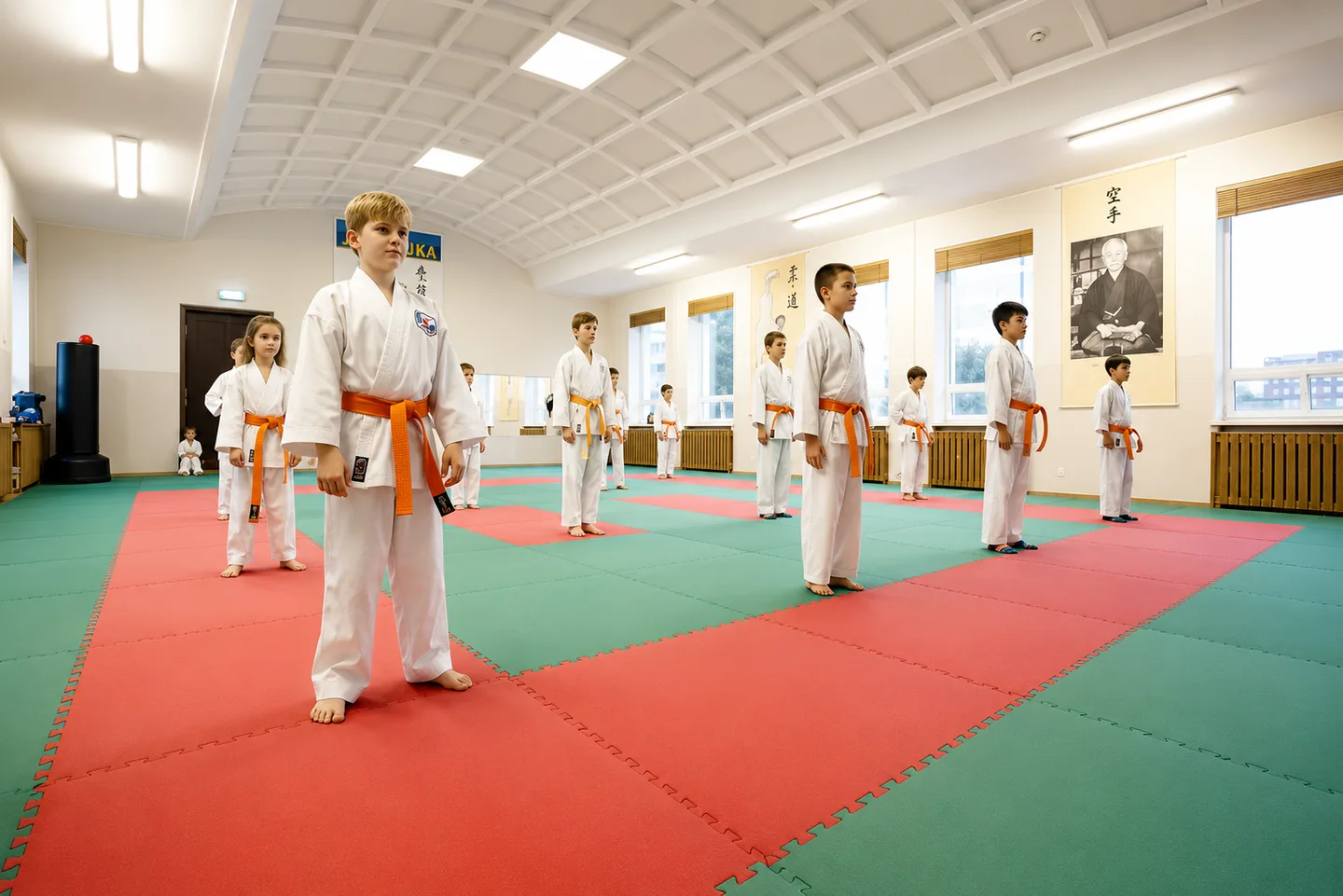
What is karate?
"Karate" means "empty hand" in Japanese. Budo — the way of the warrior.
WKF sport karate consists of kata and kumite (a sparring bout between two athletes). In kumite, controlled punches and kicks to the head and torso, throws and leg sweeps with a finishing strike are permitted and scored. For adults, all strikes to the head are essentially non-contact (from skin touch up to 5 cm); for children, cadets and juniors, hand contact to the head is forbidden — technique is scored from up to 10 cm from the body.
Sport karate has World and European Championships, and in 2021 the Olympic Games were held under WKF rules.
What does karate give you?
At our BUDO club, athletes learn correct striking and throwing technique (kihon), how to fall safely and get up quickly, tactically sound fighting and kata. In the future this will let them stand up for themselves in any life situation.
Not everyone will reach the top in sport, but everyone achieves their own victory, overcomes fears, improves physical condition, builds willpower, reduces aggression — and becomes better overall.
Sport karate is a martial art where individual human qualities shine through clearly; a discipline that harmoniously develops not only physical and coordination abilities but also mental ones, thanks to its complexity and the constant need to control the situation; a discipline that preserves and strengthens the health of those who practise it as much as possible.
At the same time, while paying attention to studying kihon and kata as a martial art, the coaching staff and athletes carefully preserve the centuries-old foundations of traditional karate, rooted in ancient Indian and Chinese philosophy.
A karate athlete's psycho-physical qualities are shaped through purposeful and intensive work on the body. Strict self-discipline and a sufficient volume of physical training are meant to develop strength of character, diligence and humanity. Karate is incompatible with aggression. Among karate masters, a popular saying goes: "You think karate is a strike — in reality, karate is a bow."
The bout (kumite)
A bout in sport karate (WKF rules) takes place on an 8×8 metre tatami (the competition area ends at the red part of the tatami) plus an additional 2-metre safety zone on each side.
Individual bouts are held by weight category. The OPEN category (regardless of weight) has not been held since 01.01.2009. In team bouts ("wall against wall"), weight categories are not taken into account.
Bout duration: up to 2 minutes for children, cadets (14–15 years), juniors (16–17 years) and women; 3 minutes for men over 18. The bout ends when time runs out or on an 8-point lead.
If points are equal, the referee calls Hantei — all 4 judges and the referee indicate who they favour. The winner is decided by majority vote.
WKF scoring system
After each correctly performed technique, scored by at least 2 judges, the referee stops the bout, calls the technique in Japanese and shows the number of points.
AKA/AO IPPON — three points. The referee raises an arm at a 45° angle towards the athlete who scored.
AKA/AO WAZA-ARI — two points. The referee extends an arm horizontally at shoulder level.
AKA/AO YUKO — one point. The referee extends an arm downward at a 45° angle.
3 points — a kick to the head, or a strike to an opponent whose torso is on the tatami after a throw.
2 points — kicks to the torso.
1 point — all hand strikes to permitted areas.
Points and violations are recorded on the scoreboard. Warnings accumulate across 2 separate categories. No points are awarded to an athlete for the opponent's warnings.
Uniform and equipment
During a bout, athletes must wear a white karate uniform (karategi) with WKF-approved patches. Mandatory: mouthguard, gloves, foot protectors, and a red (AKA) or blue (AO) belt, plus a white vest under the uniform. Women must also wear chest protection. A groin guard is recommended for everyone.
All uniforms and protective gear must be certified by WKF or EKF.
Belt system at SK BUDO
The belt system follows Shotokan traditional karate requirements.
Coloured belts: white, yellow (9–8 KYU), orange (7), green (6), light blue (5), dark blue (4), light brown (3), brown (2), dark brown (1 KYU). Black belts: 1st–10th Dan.
Partners and seminars
The club maintains ongoing contact with leading karate instructors:
— traditional karate — IJKA Shotokan;
— sport karate — Antonio Oliva Seba, 7th dan, Spain;
— kobudo (bo, hanbo, sai, tonfa etc.) — Rainer Seibert, 6th dan, Germany.
These masters hold seminars at the club every year in line with global karate methodologies.
The coaching staff welcomes parents and friends attending competitions and taking part in the club's everyday life.