Dear parents!
Sooner or later you will need to choose a sports club for your child. Please consider three key points — this applies to any sport:
— the coach's personality and education, and mandatory certification by the Estonian Olympic Committee (coaching category);
— the club's facilities, where your child will be training;
— the club itself — its history and sporting achievements.
Always choose the best — only then can your child's abilities fully develop.
About our club
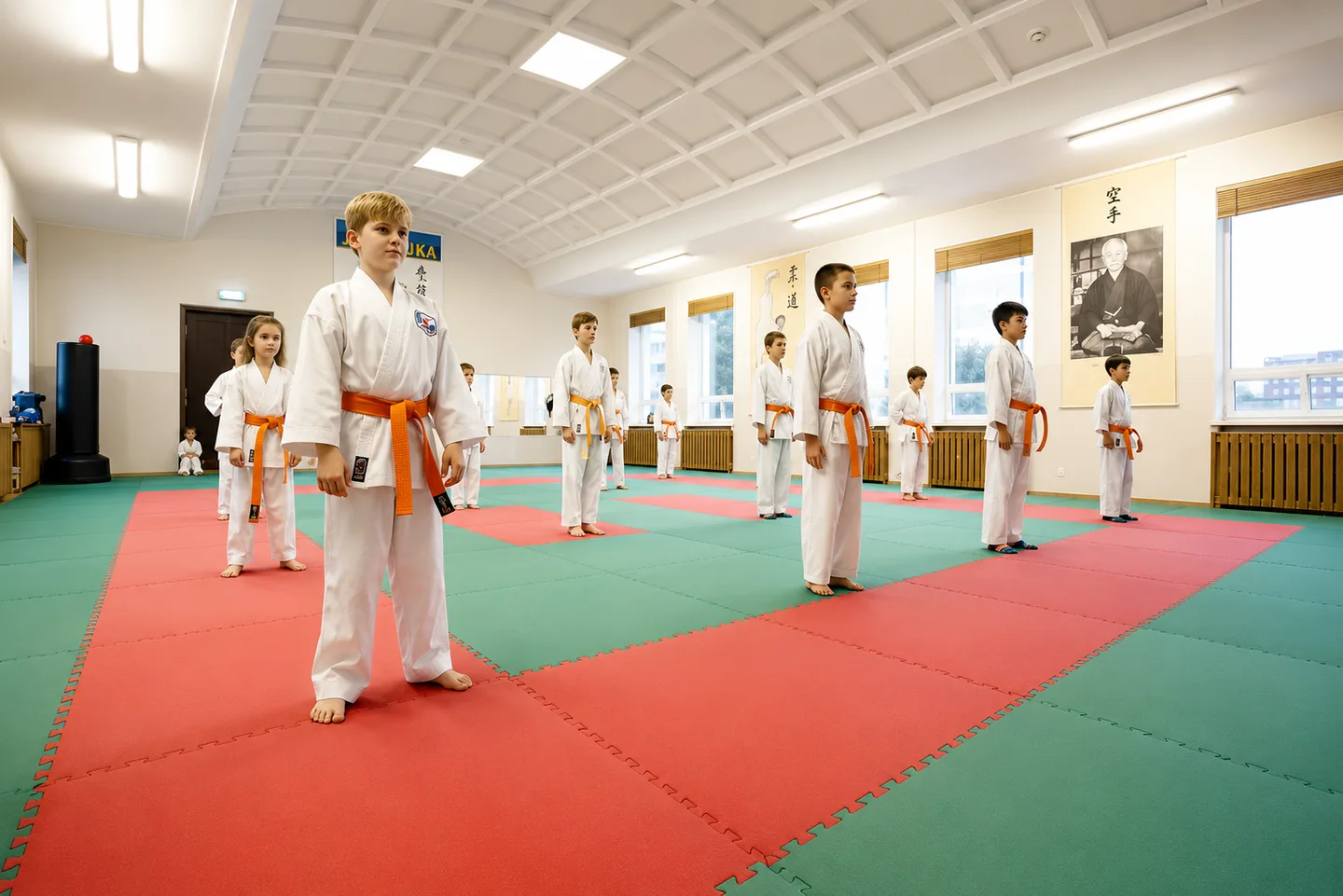
We accept girls and boys into WKF sport karate from age 6, by age group. Into kickboxing, kobudo and K-3 — from age 12.
SK BUDO's coaching staff hold higher education degrees. Head coach Alexander Zykov is a coach of the Estonian national karate team, holds the highest 7th EOC category and sits on the examination board for other coaches.
Our club's sports hall is one of the best equipped: tatami, bags, pads and more.
Sport karate (WKF) is a non-contact combat sport. In bouts, controlled punches and kicks to the head and torso without contact, plus throws, are permitted. Kata and kihon (basic Shotokan technique).
SK BUDO also teaches traditional weapon work — KOBUDO (bo staff, hanbo stick and others).
Sports school
Our club's structure includes a sports school, which admits club athletes (registered in the Tallinn city PAI system) on a contractual basis.
Admission requirements for the sports school:
— SK BUDO membership of at least one year;
— attending training at least four times a week;
— participation in the club's competitions, seminars and camps.
Only parents of athletes who are members of the sports school (not to be confused with club membership) may apply to the Tax and Customs Board for a training fee refund.
Sports school enrollment agreements are arranged individually with Alexander Zykov.
Fees (from September 2026)
SK BUDO has a fixed membership fee of 30 euros per month. The fee remains unchanged throughout the year. A monthly training fee is added on top.
Example: 30 € membership fee + 35 € training fee (2 times per week) = 65 € per month total.
2 times per week - 65€
3 times per week - 70€
4 times per week - 75€
Payment is due by the 10th of the current month.
Belt exams take place twice a year (usually December and June) and are paid separately.
Club competitions: 15 € for one category, 20 € for two categories.
The Youth and Sports Department requires clubs receiving Pearaha funding to reduce membership fees for low-income families registered in the city of Tallinn (SK BUDO complies with this) and to offer training frequency based on age: children under 7 — 2 trainings per week of 45 min, under 10 — 3–4 trainings of 45 min, and so on.
Recalculation
Fees are not recalculated if an athlete misses training for personal reasons.
If an athlete is absent for more than three weeks in a month due to illness or injury, 50% of the training fee will be refunded upon presentation of a medical certificate from the treating physician. The refund is credited towards the following month's payment.
The obligation to pay the 30 € monthly membership fee remains during the summer period. Athletes who miss more than 50% of training for a valid reason resolve payment matters individually.
Seminars and camps
SK BUDO organizes karate and kobudo seminars conducted by top-class foreign masters. Seminars are open to those interested for an additional fee. Athletes who take part in seminars perform better against the Shotokan belt system requirements, which helps them pass their exams more successfully.
Summer camps for athletes are held every year in July. Camp fees can be paid throughout the year.
SK BUDO athletes may take part in international competitions with the permission of a doctor and coach, provided they have insurance. They pay competition entry fees themselves. The club partially subsidizes athletes' transport to competition venues within Estonia.
Important recommendation
We DO NOT RECOMMEND enrolling a child under 12 in a discipline where full-contact bouts are held and knockout is a winning criterion. A knockout is at minimum a concussion (bruise, hematoma or contusion) of the brain. No protective helmet prevents the brain from striking the skull during a sharp turn of the head.
We want your child to grow up healthy and to decide for themselves, with a sound mind, what to pursue further. Any full-contact discipline will happily take a smart, healthy athlete with excellent technique from sport karate and retrain them in a short time.