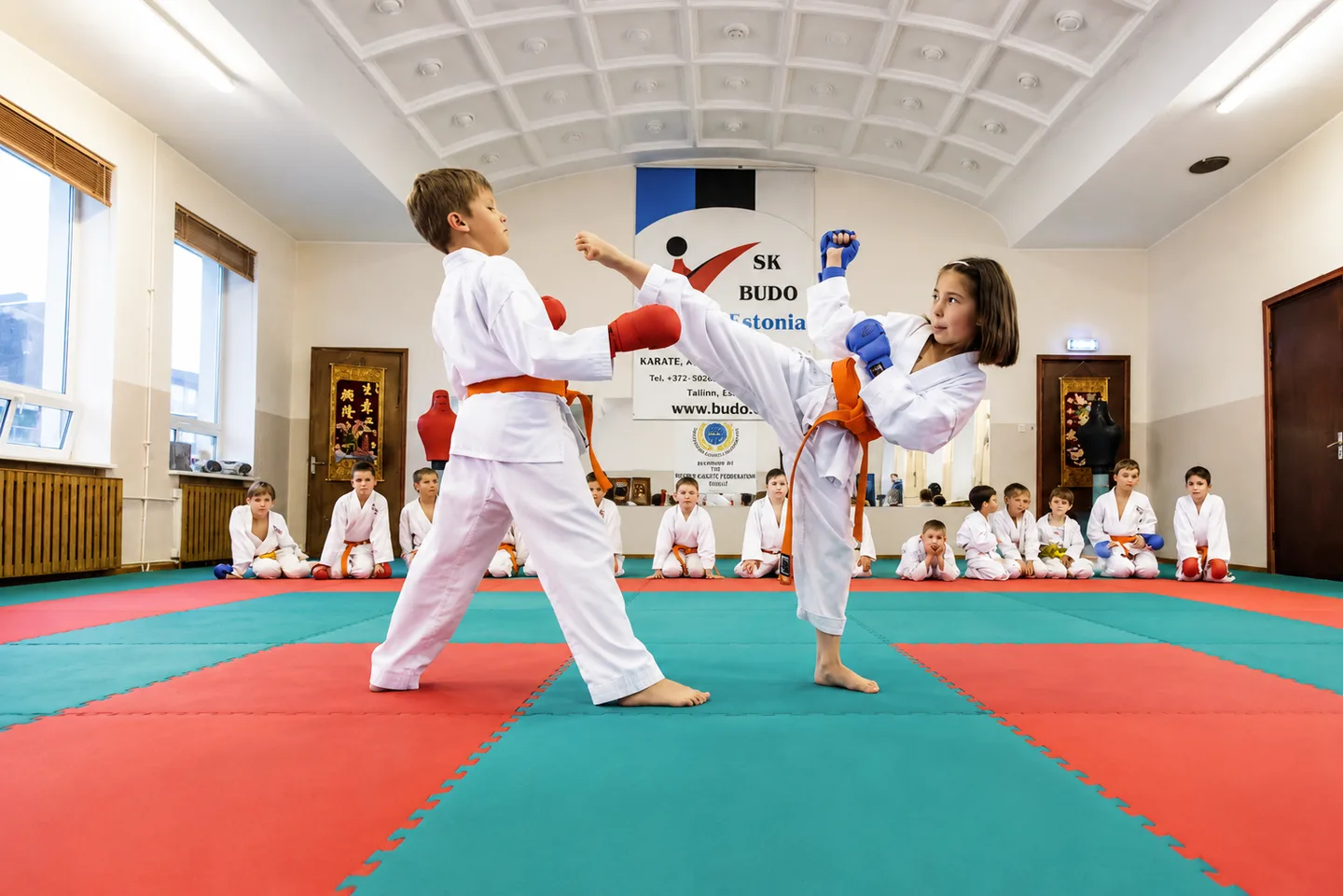
General provisions
Core elements of the WKF karate rules from 01.2017. For athletes aged 14 and over. For children under 14, the federation sets its own rules.
In kata competitions, kata of any style included in the WKF list are permitted.
Bouts take place on an 8×8 metre tatami (the competition area ends at the red part of the tatami) plus an additional 1-metre safety zone on each side.
Individual kumite bouts are held by weight and age category, separately for men and women.
Age categories
U-16 CADET, U-18 JUNIOR — hand strikes to the head with contact are forbidden and constitute a rule violation. Hand strikes to the head are scored up to 10 cm away. Kicks to the head are permitted up to 10 cm away or with light contact.
MALE +18, FEMALE +18 and U-21 — hand and foot strikes with skin contact to the head or up to 5 cm away are permitted.
The OPEN or ABS category has not been held since 01.01.2009. In team bouts, weight categories are not taken into account.
Judging panel
Panel: 4 Judges, 1 Referee, 1 Match Supervisor (Kansa).
The Referee does not award points themselves — they only announce the points given by the Judges. The Referee takes part in resolving ties: if 2 judges favour one decision and 2 favour another, the Referee joins one of the decisions.
The four Judges are positioned at the corners of the tatami.
Stopping the bout
If at least 2 Judges signal points or a JOGAI violation with their flags, the Referee must stop the bout and award the points or issue a warning for the violation.
The decision is made by a simple majority of the Judges. If 2 judges register AKA and 2 register AO technique simultaneously, both athletes receive the corresponding points.
If the Judges' scores differ, the LOWER score is awarded when there is no majority for the same score.
The Referee may stop the bout independently for a violation but bases the decision on 2 or more Judges. If the Judges have not reached a decision, the Referee simply continues the match.
If the Referee indicates excessive contact occurred, scores previously shown by the Judges may be changed.
Scoring for technique (new names from 2017)
1 point — YUKO: all hand strikes to the head and torso.
2 points — WAZA-ARI: a kick to the torso.
3 points — IPPON: throws with a finishing strike, and a kick to the head.
Permitted attack areas: head, face, neck, abdomen, chest, back and side.
3 points are awarded for a kick to the head (face, head and neck) or a strike to an opponent whose torso is fully on the tatami after a throw or fall.
2 points — kicks to the torso.
1 point — all hand strikes to permitted areas.
Any contact with the throat is forbidden and constitutes a rule violation.
Bout duration
2 minutes for: Male/Female U-16 cadets (14–15 years), U-18 juniors (16–17 years), Female U-21 and adult women.
3 minutes for men over 18.
Violations and penalties
Passivity has been added to the list of prohibited Category 2 behaviour (the Referee rotates their fists in front of the chest).
Category 2 violations in the last 10 seconds are warned at a minimum of Hansoku Chui.
Exaggerating an injury — minimum C2 Hansoku Chui. Simulating a non-existent injury — SHIKAKU.
No points are awarded to the opponent for an athlete's warnings. In team matches, a KIKEN or Hansoku/Shikaku loss is recorded as 0:8.
Warnings are given across 2 separate categories, which do not accumulate together.
Excessive contact, strikes to prohibited areas and illegal throws are Category 1 violations. Grabs below the belt and with both hands are forbidden (exception: grabbing a leg after an opponent's kick followed by an immediate throw).
Deciding the winner
The winner of an individual bout is decided by the majority of points scored, or by the decision of the Judges and Referee in case of a tie — Hantei takes place immediately after the end of regular time, when the 4 Judges and the Referee cast their decision.
A draw can only occur in team competitions. An additional bout is arranged to decide the winner of a team match.
Uniform and equipment
During a bout: a white karate uniform (karategi) with only WKF-approved patches, a mouthguard, gloves, a white vest under the uniform, foot protectors, and a red (AKA) or blue (AO) belt. Women must also wear chest protection. A groin guard is recommended for everyone.
Women may wear a headscarf that does not cover the neck. Glasses are forbidden; soft contact lenses are permitted. Hair must be clean; hairpins and clips are forbidden, a hair tie for a ponytail is permitted.
All uniforms and protective gear must be certified by WKF or EKF.